

A Personal Reflection on Finding My Inner Light in the Kitchen this Diwali!
The dust has settled. The diyas are illuminated. My residence now exudes the aroma of cardamom and Ghee, rather than only that of cleaning spray. It is the ideal moment of Diwali, when the outward commotion subsides, leaving us with the soft, flickering illumination.
Annually, I prepare Besan Laddus for Diwali. Besan Laddu is a traditional Indian sweet made from roasted Besan (gram flour), Ghee (clarified butter), and sugar. They are known for their nutty aroma and melt-in-your-mouth texture. They are uncomplicated, reassuring, and require concentration. Recently, I have come to understand that this recipe transcends mere dessert; it serves as a profound metaphor for the journey of enlightenment. The Laddu represents the ultimate state of complete happiness; what is the recipe? That constitutes my personal kitchen-oriented Yoga Shastra.
The Recipe: Enlightenment Laddu
The ingredients are simple, but the mixing requires you to be present in the moment.
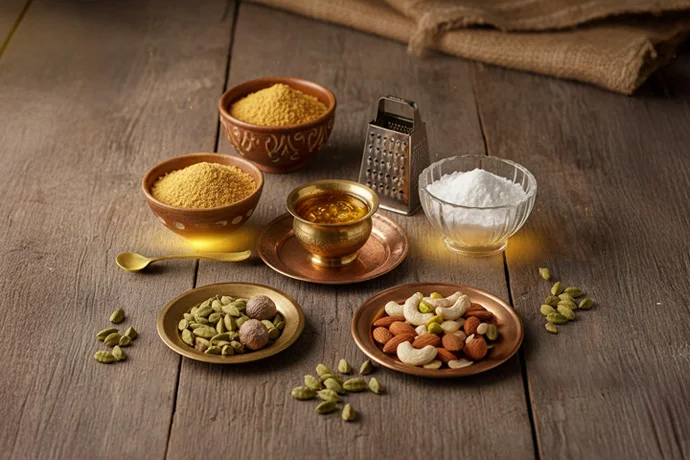
| Ingredient | The Divine Counterpart | The Importance |
| 1 Cup Besan (Gram Flour) | Selfless Action (Karma Yoga) | It is the unconditional commitment of fulfilling one’s responsibilities without anticipation of outcomes, which in turn leads to purification of the mind. |
| 1/2 Cup Pure Ghee | Consciousness (Chitta) | This is the origin of unadulterated purity and energy. It facilitates the liquefaction and transformation of the dry flour (effort). It signifies the concentrated attention we apply to any endeavour. |
| 3/4 Cup Powdered Sugar | Devotion & Love (Bhakti) | The sweet binder. Devotion is essential to render the labour of Karma fulfilling. Devotion is the force that ensures the practice endures. |
| Cardamom, Nutmeg, Dry Fruits | The Tools (Pranayama, Viveka) | This constitutes the Sadhana, a daily regimen. These are the supplementary instruments that enhance the flavour, the subtle practices like Asanas, Pranayama, breathwork and self-introspection that refine your experience. |
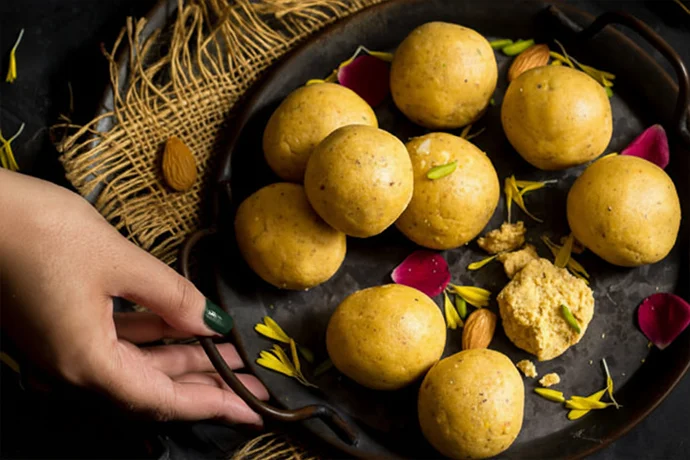
The Soulful Recipe (The Path to Peace)
Step 1: The Roasting of Ego (Tapasya)
Position your heavy-bottomed Kadhai (the world) on a stable, flame (your unwavering determination). Add the Besan and Ghee. Proceed to roast delicately. This constitutes the most challenging aspect. The flour will initially be rigid and arid, adhering to the bottom and resisting dissolution. This phase represents your Tapasya, the intensity of your practice purging the ego’s resentment. Continuous stirring is required. If you stop, it will burn. Dedication is paramount.
Step 2: The Softening (Dissolving Dualities)
Continue to stir. Approximately twenty minutes later, a miracle occurs. The Besan will abruptly soften and expel the Ghee. The paste attains a silky, aromatic, and golden quality. This signifies the point in your practice when dualities disintegrate. Your rigid opposition diminishes. You are no longer resisting the present; you are harmonizing with it. The authentic essence is unveiled.
Step 3: The Cooling and Waiting (Vairagya & Patience)
Transfer the mixture to a cool dish and allow it to rest. This exemplifies Vairagya (non-attachment). The mixture must be allowed to cool sufficiently to be handled. Incorporating the sugar prematurely will cause the mixture to become liquid. One must await the cooling of early fervour and the establishment of a composed concentration.
Step 4: The Binding (Samadhi)
Incorporate the sugar (Bhakti) and the spices (Viveka) into the cooled mixture. Utilize the pressure of your hands (your determination) to unite the elements. The concoction retains its shape solely when all components are well amalgamated: the heat, the sweetness, the effort. This cohesive form is your Laddu of Enlightenment. It is the state of Samadhi, wherein all acts, knowledge, and devotion are seamlessly integrated.
The Taste of True Light
This Diwali, while you savour the delicious, aromatic Laddu, reflect on the spiritual endeavour required to achieve that flawless shape. Enlightenment is not an external discovery rather it is an internal work. It is a harmonious amalgamation of consciousness, dedication, and action.
This shows that even the most basic daily activities can serve as potent yogic instruments if practiced with a single point of focus, like sitting on a mat or stirring a pot of Besan. We must recognize the clarity in the process.

